
Feltham, England · Tyre Guide
That string on your tyre sidewall is not random. Learn what it means before you order the wrong tyre, change your wheel size or pay for a poor fit.
What this guide covers
- Tyre Size Meaning: What 205/55 R16 Really Tells You
- How to Read Tyre Size Markings Without Guessing
- Why Width and Aspect Ratio Change How Your Car Feels
- What the Load Index and Speed Rating Mean
- Where to Find Your Correct Tyre Size in the UK
- Can You Change Your Tyre Size?
- Common Tyre Markings Worth Checking
- How to Choose the Right Replacement Tyre in Feltham
- Frequently Asked Questions
Key Takeaways
- Tyre size meaning starts with width, aspect ratio, construction and rim diameter.
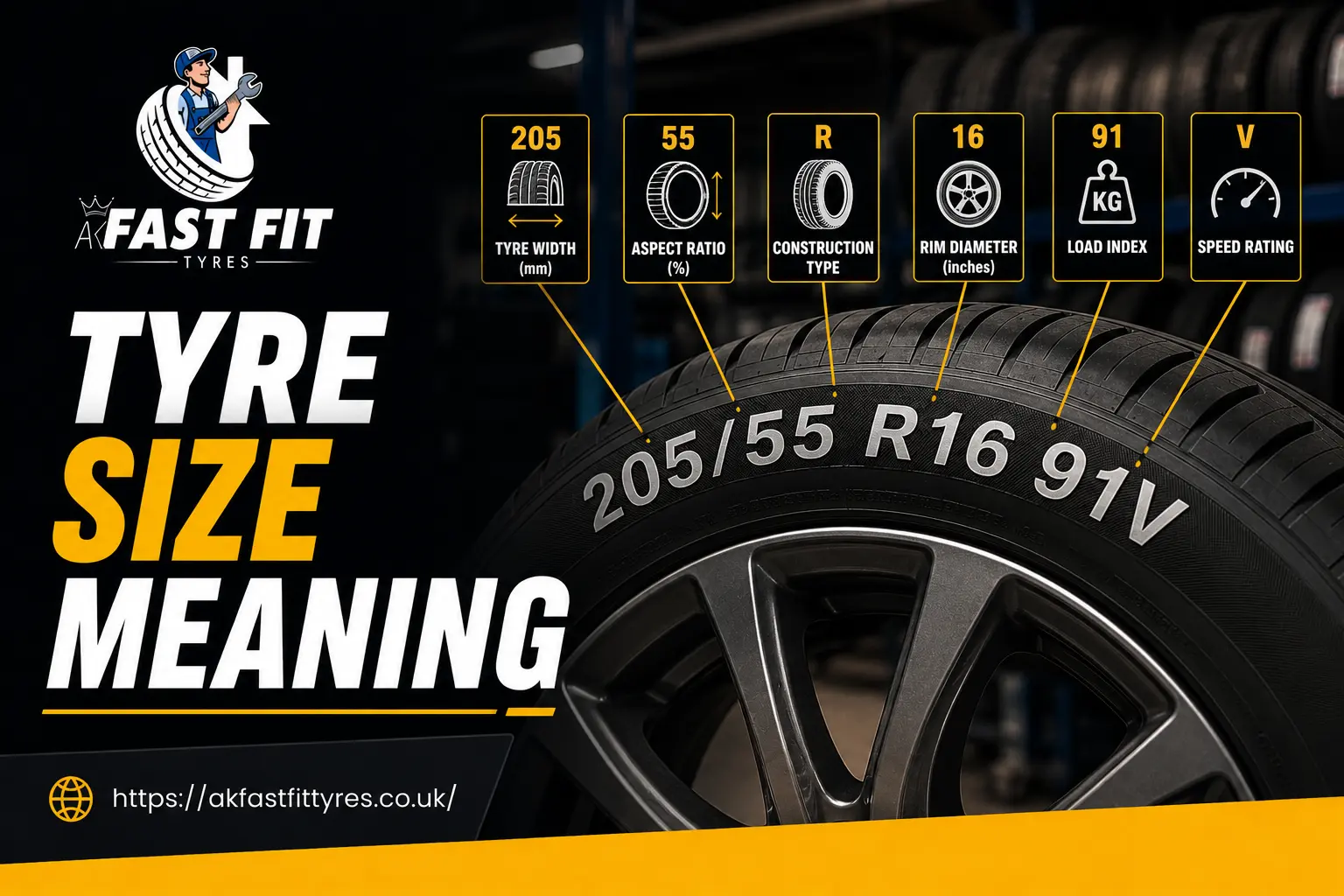
- In 205/55 R16 91V, 205 is width, 55 is aspect ratio, R is radial, 16 is rim diameter, 91 is load index and V is speed rating.
- Your current tyre is useful for reading the code, but your vehicle handbook or manufacturer label should confirm the approved size.
- A wider tyre or lower profile is not automatically better. Fitment must suit the vehicle, wheel and manufacturer specification.
- Check the complete tyre marking before buying. Size alone does not tell the whole story.
Have you ever been asked for your tyre size and stared at the sidewall wondering which numbers matter? You are not alone. A code such as 205/55 R16 91V looks technical, but you can break it down in seconds.
Understanding tyre size meaning helps you avoid one of the easiest tyre-buying mistakes: choosing something that looks close but does not match your vehicle’s approved specification. The wrong width, profile or rim size can affect fitment and driving behaviour.
This guide uses simple examples and UK terminology. By the end, you will know how to read your tyre sidewall, check the information on your car and know when you should ask a tyre fitter to confirm the correct replacement.
Tyre Size Meaning: What 205/55 R16 Really Tells You
The easiest way to understand tyre size meaning is to split a common code into parts. Take 205/55 R16 91V. The first four elements describe the tyre’s main dimensions and construction. The final number and letter describe its load and speed ratings.
How to Read Tyre Size One Part at a Time
205 is the nominal section width in millimetres. 55 is the aspect ratio, so the sidewall height equals 55% of the tyre width. R means radial construction. 16 means the tyre fits a 16-inch rim.
Then comes 91V. The 91 is the load index. The V is the speed rating. These ratings are not part of the physical width or diameter, but they matter when you select a replacement tyre.
This same core sidewall system applies across every major tyre brand sold in the UK, since it follows a shared international standard rather than something set by any one manufacturer. Extra letters and symbols alongside the main code can add further detail about tyre type, load capacity, winter performance, original equipment approval and other specifications, which is covered in more depth later in this guide.
Decode 205/55 R16 91V
Read the code from left to right. Each section answers a different fitment question.
Width in mm
Aspect ratio
Radial + rim
Photograph the full tyre sidewall before you call a tyre shop. Make sure the photo includes the complete code, not just the first three numbers. It can save time and reduces the chance of quoting the wrong tyre.
How to Read Tyre Size Markings Without Guessing
If you want the practical version of tyre size meaning, start with the sidewall. Look for a sequence similar to 195/65 R15, 205/55 R16 or 225/40 R18. The format can vary slightly, but the main size information follows the same logic.
What Does the First Number in a Tyre Size Mean?
The first number shows the nominal tyre width in millimetres. A 225 tyre has a nominal section width of 225 mm. This measurement refers to the tyre’s section width rather than simply the part of the tread touching the road.
What Does the Second Number Mean?
The second number is the aspect ratio. It expresses the sidewall height as a percentage of the tyre’s width. For a 205/55 tyre, the nominal sidewall height is 55% of 205 mm, which is about 113 mm.
A lower aspect ratio normally gives a shorter sidewall. A higher aspect ratio gives a taller sidewall. This can affect comfort, steering response and the amount of cushioning between the road and the wheel.
What Does R Mean in Tyre Size?
R means radial construction. Most modern passenger car tyres use radial construction. It describes how the tyre’s internal cords are arranged, rather than the tyre’s size in millimetres.
What Does the Last Number Mean?
The number after R identifies the wheel rim diameter in inches. In 205/55 R16, the 16 means the tyre is designed for a 16-inch rim. The tyre and rim must be compatible, so this is not a number you can change casually.
| Marking | Meaning | What it tells you |
|---|---|---|
| 205 | Width | Nominal section width in millimetres |
| 55 | Aspect ratio | Sidewall height as a percentage of width |
| R | Construction | Radial tyre construction |
| 16 | Rim diameter | Wheel diameter in inches |
| 91 | Load index | Maximum load code for one tyre under the specified conditions |
| V | Speed rating | Speed category assigned to the tyre under specified test conditions |
Why Width and Aspect Ratio Change How Your Car Feels
Knowing tyre size meaning is useful, but the numbers also have a practical effect on your driving. Width and aspect ratio influence the tyre’s shape, sidewall height and contact with the road. They can change steering response, ride comfort and how your car reacts to bumps.
Wider Tyres Are Not Automatically Better
A wider tyre can offer more road contact in some conditions, but width also brings trade-offs. It can increase rolling resistance, affect steering effort and cost more. If the tyre is too wide for the vehicle or wheel, it can also create clearance problems.
For a daily driver around Feltham, Hounslow, Hanworth, Bedfont or nearby areas, the safest starting point remains the size approved for your exact vehicle. Your car’s design matters more than chasing a larger-looking tyre.
Think in Four Dimensions
Tyre size is not just a number. It describes the shape and wheel connection of the tyre.
Width
Measured in millimetres. It helps describe the tyre’s overall section width.
Profile
The aspect ratio sets sidewall height as a percentage of width.
Construction
R normally identifies radial construction on modern passenger tyres.
Rim Diameter
The final number in the main size is the wheel rim diameter in inches.
Do not assume that a lower profile or wider tyre is an upgrade. If it sits outside the vehicle’s approved specification, the change can create fitment and handling problems. Check the approved sizes first.
What the Load Index and Speed Rating Mean
One of the biggest gaps in basic tyre size meaning guides is the information after the rim diameter. A code such as 205/55 R16 91V includes a load index and speed rating. You need to check both when replacing tyres.
Load Index: How Much Weight Can the Tyre Carry?
The load index is a numerical code linked to the maximum load a single tyre can carry under specified conditions. For example, 91 is a common passenger-car load index, but you should not select it just because you recognise it.
Your vehicle manufacturer sets the required specifications for the car. A replacement should meet the approved load requirement for your vehicle and intended use.
Speed Rating: What Does the Letter Mean?
The final letter is the speed rating. It represents the tyre’s approved speed category under specified test conditions when correctly loaded and inflated. It is not a target speed for road driving.
You may see letters such as T, H, V, W or Y on passenger car tyres. The correct rating depends on the vehicle. If you are unsure, use the vehicle handbook or manufacturer information rather than choosing a rating by appearance.
This is also why the question “what does the letter mean at the end of a tyre size?” needs context. The letter can be the speed rating when it follows the load index, but other letters elsewhere on the sidewall can describe construction, tyre type, winter use or vehicle-specific approval.
The Safe Replacement Check
Use this order before you buy a replacement tyre.
Where to Find Your Correct Tyre Size in the UK
The easiest place to read tyre size meaning is the sidewall, but do not rely on the sidewall alone if you suspect the car has modified wheels or an incorrect tyre fitted already.
Check the Driver’s Door Frame
Many vehicles have a tyre information label on the driver’s door frame or B-pillar. It can show approved tyre sizes and recommended pressures. The exact location varies by vehicle.
Check the Handbook and Manufacturer Information
Your vehicle handbook can list approved tyre sizes, wheel specifications and pressures. Most manufacturers also print this information near the fuel filler flap and within the official vehicle documents, so there are usually two or three places to cross-check if the handbook is not to hand.
Do Not Copy Another Car
Two cars with the same badge can use different tyre sizes because of model year, engine, trim level, wheel package or market specification. A friend’s tyre size is not evidence that your car uses the same size.
If the sidewall code and the vehicle label do not agree, stop before ordering. A tyre specialist can check the vehicle specification and confirm what should be fitted.
Can You Change Your Tyre Size?
You can change tyre size on some vehicles, but you should not treat it as a simple styling decision. The approved wheel and tyre combinations depend on the vehicle. Changing width, profile or rim diameter can affect clearance, rolling circumference, handling and electronic systems.
What Happens if You Fit the Wrong Size?
Some vehicles are designed with different front and rear tyre sizes as standard, known as a staggered fitment, so it is not always a mistake to see two sizes on the same car. What matters is that each size matches the manufacturer’s specification for that axle. Fitting sizes outside the approved specification, on any axle, can affect steering, braking and stability.
What About 225/40 R18 Tyres?
225/40 R18 is a useful example because it shows how much information sits inside one short code. The 225 describes width, 40 describes aspect ratio and R18 indicates radial construction with an 18-inch rim. You would still need to check the load index, speed rating and vehicle approval before buying.
The fact that 225/40 R18 fits one car does not make it suitable for another. This is especially relevant if you are moving from smaller wheels to larger alloys. The complete vehicle specification must support the change.
Common Tyre Markings Worth Checking
Once you understand tyre size meaning, you can start reading the smaller markings around the sidewall. These markings can help you understand the tyre’s intended use and identify the exact product.
XL, Reinforced or HL
These markings can indicate a tyre designed for a higher load capacity than a standard tyre of the same dimension. An XL, HL or Reinforced tyre should generally be replaced with the equivalent type where the vehicle manufacturer requires it.
3PMSF and M+S
You may see a mountain and snowflake symbol called 3PMSF on tyres designed and tested for winter performance. M+S means Mud and Snow, but the marking alone does not carry the same objective winter-performance test as 3PMSF.
OE Markings
Some tyres carry an original-equipment marking linked to a vehicle manufacturer. These markings can identify tyres developed or approved for particular vehicles. If your vehicle requires an OE specification, check that requirement before ordering.
What Is the N Rating on Tyres?
An N marking can identify a tyre approved for a Porsche fitment. It is an original-equipment or homologation marking, not the speed rating. This is a useful distinction because a letter on the sidewall can have different meanings depending on where it appears.
Manufacturing Date
A tyre also carries a date code. The final four digits of the DOT code commonly show the week and year of manufacture. For example, 2425 indicates the 24th week of 2025. The date is useful when buying part-worn tyres or checking the age of tyres already fitted.
Tyre condition still matters more than chasing a single number. Look for cuts, bulges, cracks and uneven wear. If you spot damage, get the tyre inspected rather than assuming the size code tells you whether it is safe.
If you are considering part-worn tyres, ask to see the complete sidewall markings and check the tyre condition before fitting. A correct size does not make a damaged tyre suitable.
How to Choose the Right Replacement Tyre in Feltham
For drivers in Feltham and nearby West London areas, the easiest route is to bring the vehicle or the complete sidewall information to a tyre specialist. If you already know the approved size, you can compare new and part-worn options based on your budget and driving needs.
At AK Fast Fit Tyres, you can ask for help matching your vehicle to the correct tyre specification. If you are unsure about the size, do not guess from a partial code.
What Should You Compare Besides Tyre Size?
Compare the load index, speed rating, tyre type and any manufacturer-specific requirement. Then consider the type of driving you do. A daily city driver may value comfort and low noise. A motorway driver may place more emphasis on wet grip, stability and long-distance performance.
If a puncture or visible damage has started this search, our guide to tyre puncture repair in Feltham explains when a repair may be possible and when replacement makes more sense.
When Should You Ask a Tyre Fitter to Confirm the Size?
Ask for confirmation if the tyre markings are damaged, the car has aftermarket wheels, the front and rear sizes differ, the current tyres look unusual or the handbook and sidewall information do not match. A quick check can prevent an expensive fitment mistake.
AK Fast Fit Tyres Team
Independent Tyre & Garage Specialists, Feltham
This guide was written by our in-house team and reviewed by our head technician before publishing. Between us, we have spent over 15 years reading tyre sidewalls, matching replacements to vehicle specifications and fitting tyres for drivers across Feltham, and every recommendation here reflects what we actually check on the workshop floor each week.
- 15+ Years Local Experience
- Sizes Checked on Every Fitting
- Feltham Town Centre Garage
Frequently Asked Questions
What does tyre size meaning refer to?
Tyre size meaning refers to the numbers and letters that describe a tyre’s dimensions and construction. In 205/55 R16, 205 is the width, 55 is the aspect ratio, R means radial construction and 16 is the rim diameter in inches. Extra markings such as 91V add load and speed information.
How do I know what tyre size my car needs?
Check the tyre sidewall, then confirm the information against the vehicle handbook or the manufacturer’s tyre label. The driver’s door frame, fuel filler area and other vehicle documents can also show approved sizes. If the current tyres differ from the manufacturer’s specification, do not copy them without checking first.
What does 205/55 R16 mean?
205/55 R16 means a nominal width of 205 mm, a sidewall height equal to 55% of the width, radial construction and a tyre designed for a 16-inch rim. If the full marking reads 205/55 R16 91V, 91 is the load index and V is the speed rating.
What does the letter at the end of a tyre size mean?
When the final letter follows the load index, it normally represents the tyre’s speed rating. For example, V in 91V is a speed category. Other letters elsewhere on a tyre sidewall can have different meanings, so read the whole marking rather than treating every letter as a speed rating.
Can I fit a different tyre size to my car?
Only if the alternative size is approved or properly confirmed for your specific vehicle and wheel setup. Changing width, profile or rim diameter can affect clearance, handling, rolling circumference and vehicle systems. Check the manufacturer’s approved specifications before changing size rather than choosing a tyre because it looks similar.
Is 225/40 R18 a common tyre size?
225/40 R18 is a tyre size used on some passenger cars, but it is not automatically suitable for every vehicle with 18-inch wheels. The code means 225 mm width, 40 aspect ratio and an 18-inch rim with radial construction. Always confirm the load, speed and vehicle-specific fitment before buying.
Know Your Size? Let AK Fast Fit Tyres Check the Fit
Bring your tyre details to our Feltham team or contact us for help choosing a suitable replacement. We can help you move from confusing sidewall numbers to the right tyre specification.
Contact AK Fast Fit Tyres →